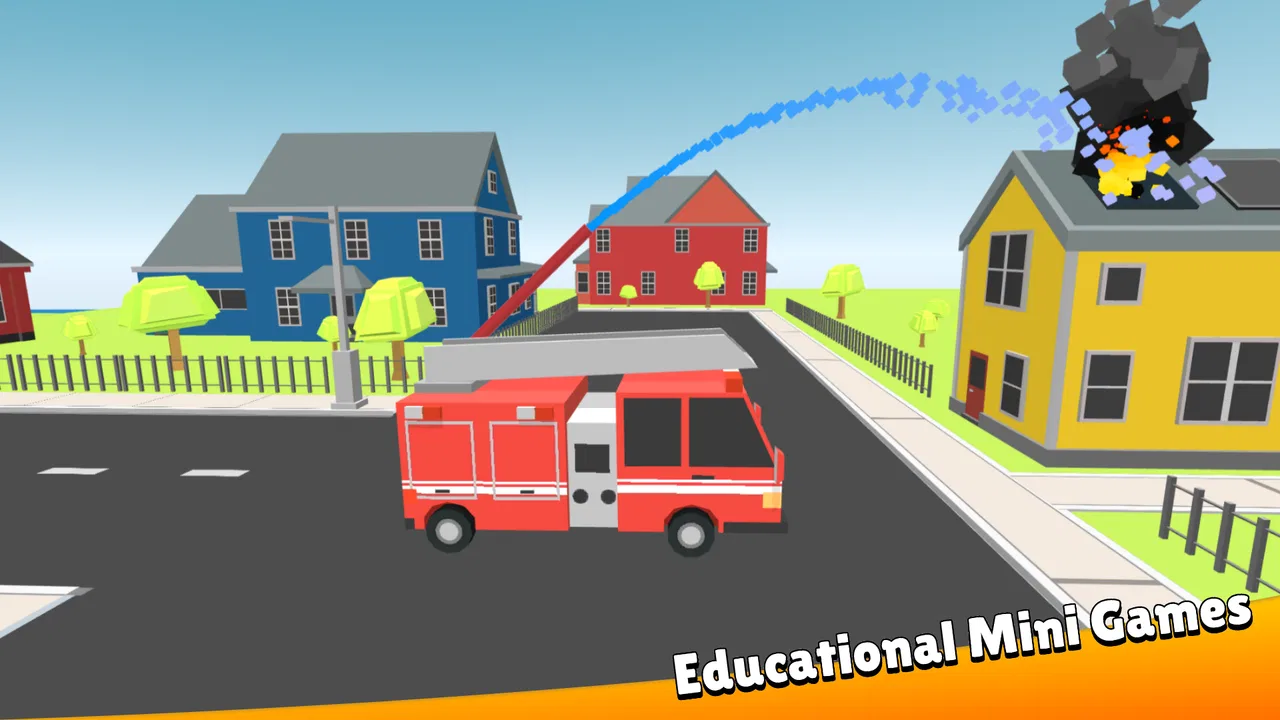
City Patrol : Rescue Vehicles
- 3.5
- Rating
- 50.00M
- Installs
- Free
- Price

 Analysis by App-foxy
I spent time with City Patrol: Rescue Vehicles as a child-friendly educational game built around emergency and service vehicles. Its appeal is easy to understand: it gives young players a playful way to recognize the vehicles they may see helping people in everyday life. I found it most suitable for short, supervised sessions rather than long gaming marathons, especially when an adult joins in and turns the pictures and actions into a conversation about safety, community workers, and what different vehicles do.
The game is free to download, which makes it simple to try without committing money at the start. It is made by Edugamus and carries an Everyone age rating, so its intended audience is broad and family-friendly. The current release is version 2.3.0 and works on devices running Android 7.0 or later. Optional purchases range from $1.99 to $3.99 per item, so parents should still check the purchase settings before handing a device to a child.
How City Patrol turns vehicles into small learning goals
The strongest part of the experience is its clear subject. Instead of asking a child to learn through abstract quizzes or long explanations, it uses emergency and service vehicles as the central theme. That gives the child an immediate goal: identify what is on screen, understand its role, and connect it with a real-world situation. A fire engine, ambulance, police vehicle, or other service vehicle becomes more than a colorful object; it can prompt a useful question about who uses it and why.
You May Also Like

 Blood Strike: 2.5 Anniversary
Blood Strike’s Loadouts Turn Every Drop Into a Tactical Gamble
A close look at Blood Strike’s custom loadouts: how fast access to signature weapons reshapes its battle royale rhythm, rewards preparation, and narrows the gap between fights.

 Pandora - Music & Podcasts
Pandora’s Music Is Easy to Start, but Harder to Recover
Pandora’s strength is its low-effort path from a seed to a station. Its weak spot is how much confidence it asks you to place in connection, setup, and quiet recovery.

 8 Ball Pool
 Is Built on Rivalries, Rematches, and Routine
A close look at the rivalries, rematches, shared routines, and unanswered safety questions that turn a quick pool match into a persistent mobile community.

 Samsung Music
’s Quiet Strength Is Playing What You Already Own
Its reach comes less from spectacle than from dependable access to a personal library. That simplicity is both the app’s strongest retention engine and its ceiling.

 AccuWeather: Weather Radar
AccuWeather Review: A Quick, Clear Forecast for Everyday Decisions
For everyday plans, the best forecast is the one you can understand quickly. AccuWeather makes rain timing, radar, and local conditions easy to act on, with a few trade-offs.

 Hill Climb Racing
Why Hill Climb Racing Still Turns Crashes Into One More Run
A tiny car, a bumpy hill and one more upgrade: Hill Climb Racing keeps resurfacing because its simple chaos makes every near-miss feel personal.
More From Our News Desk
View All News


That focus also helps the game make sense to children who are still developing their attention span. In my experience, a young player is more likely to stay interested when the subject is concrete and familiar. Vehicles have recognizable shapes, sounds, colors, and purposes, so the learning does not feel like a worksheet. The best results come when the adult asks simple follow-up questions instead of giving all the answers immediately: “Which vehicle helps someone who is hurt?” or “What might this vehicle be doing in the city?”
The early goals feel approachable rather than intimidating. A child can begin by noticing visual differences and gradually attach meaning to them. That is a better starting point than expecting independent reading or detailed knowledge. For preschool and early-primary users, the game’s subject matter offers a natural bridge between play and basic vocabulary.
One useful way to play is to treat each session as a short observation exercise. Let the child point out the vehicle first, then ask what clues helped them decide. Was it the shape, the equipment, the color, or the situation shown? This turns recognition into reasoning. It also gives the adult a chance to correct misunderstandings gently without making the activity feel like a test.
Progress feels clearest when an adult adds context
The game’s progress signals are most valuable when they are connected to conversation. A child may feel successful after identifying a vehicle or completing a small task, but the deeper learning comes from explaining its purpose. I would not rely on the game alone to teach emergency behavior. Instead, I would use it as a starting point for practical lessons such as calling a trusted adult, staying away from danger, or recognizing that different services have different responsibilities.
This is one of the less obvious strengths of the concept: it can support language development as well as vehicle recognition. A child can practice words such as rescue, repair, traffic, hospital, road, and helper while describing what is happening. Parents who want an educational benefit should encourage complete sentences rather than simply accepting a correct tap. That small change makes the same play session more useful without requiring any extra feature.
For a realistic everyday example, imagine using the game during a short waiting period before dinner or while traveling. A child can play for a few minutes, then look outside and try to spot a real service vehicle. The adult can ask how the real vehicle is similar to the one in the game and how it is different. This keeps the activity grounded in the child’s surroundings and prevents the screen from becoming the entire lesson.
The game is also a reasonable conversation tool for siblings. An older child can explain a vehicle’s role to a younger one, while the younger player handles the recognition task. That arrangement gives the older child a chance to practice communication, although adults may need to step in if the older sibling starts turning the activity into a competition.
Challenge and pacing suit brief play better than extended sessions
I see the difficulty curve as intentionally gentle. That is appropriate for an educational game aimed at children, because frustration can quickly end a session before the learning has had time to settle. The subject itself supplies enough variety to keep the opening stages approachable, but the experience is not designed for players looking for complex strategy, deep problem solving, or a demanding arcade challenge.
That gentle pace is a benefit for first-time players and children who are still learning to use touch controls. It gives them room to observe before responding. It also makes the game useful in mixed-age households where a younger child may need more time than an older sibling. The trade-off is that children who already know emergency vehicles well may move through the basic learning loop quickly and look for something more challenging.
Parents should set expectations accordingly. This is not a substitute for a large educational curriculum, a driving simulator, or a detailed emergency-services reference tool. Its value is in accessible repetition and recognition. If a child becomes bored after mastering the main ideas, that does not necessarily mean the game has failed; it may simply mean the child has reached the limit of what this focused format can offer.
The pacing also makes it suitable for controlled screen time. I prefer using it as a ten-minute activity with a clear stopping point rather than leaving it open in the background. Short sessions make it easier to notice whether the child is actually learning or merely tapping quickly. They also reduce the chance that optional purchases or repeated play become the main attraction.
Unlocks, motivation, and the pressure to keep playing
The question of retention deserves a balanced view. A child may want to continue because the vehicles are appealing and because completing activities creates a sense of progress. That is a healthy form of motivation when it leads to curiosity and discussion. It becomes less useful if the child is focused only on reaching the next reward without remembering what the vehicles represent.
I would pay attention to what the child says after playing. If they can explain why a vehicle is used, the game is supporting its educational purpose. If they only ask to continue tapping, I would pause and add an offline activity. Drawing a rescue vehicle, sorting toy vehicles by job, or looking at pictures in a book can reinforce the same topic without increasing screen time.
Optional purchases are another reason for adult involvement. The game is free, but individual items cost between $1.99 and $3.99. That does not automatically make the purchase model a problem, yet parents should decide in advance whether they want to spend anything. A child should not be encouraged to treat every locked or additional item as something that must be obtained immediately. The best approach is to keep purchasing under adult control and judge any extra content by whether it adds meaningful learning rather than simply extending play.
This is also where City Patrol differs from many conventional children’s games. A typical vehicle game may focus on racing, collecting, or construction, with learning added as decoration. Here, the educational theme is the reason to play. That makes it a better choice for parents who want the subject matter to remain central, but a weaker choice for children who mainly want speed, competition, or open-ended driving.
What the rating and audience suggest in practical use
The game has an average rating of 3.9 from around eleven thousand ratings, with twenty-three written reviews shown alongside it. I read that overall score as a sign that the concept has clear appeal but may not satisfy every family in the same way. Ratings for children’s games often reflect different expectations: one parent may value a calm learning tool, while another may expect a large amount of content or more advanced challenge.
It has passed ten million installs, which shows that the vehicle theme reaches a substantial audience. Popularity alone does not tell me whether it will suit a particular child, but it does make the game easy to consider as a familiar option in the educational category. I would still judge it by the child’s age, attention span, and interest in vehicles rather than by the install figure.
The Everyone rating makes it appropriate to consider for family use, but an age label is not a substitute for supervision. Young children may misunderstand emergency situations or imitate behavior without understanding the real-world consequences. I would explain that the game is pretend and that real emergency vehicles should never be approached, followed, or distracted.
Device compatibility is reasonably broad because Android 7.0 is supported. That is helpful for families using an older phone or tablet rather than a recent flagship device. Still, the quality of a child’s experience can depend on screen size, touch responsiveness, and whether the device is shared. A larger tablet is usually more comfortable for small fingers, while a phone may be fine for a short session but less suitable for extended viewing.
Where it fits among educational alternatives
Compared with flashcards, City Patrol adds interaction and a sense of play. Flashcards can be faster for direct memorization, but they may not hold a young child’s attention for long. Compared with a picture book about community helpers, the game offers more immediate participation, while the book usually provides richer explanations and a calmer shared-reading experience. I would use both rather than treating one as a complete replacement for the other.
Compared with general preschool learning apps, this game is narrower. That narrowness is useful if a child is currently fascinated by ambulances, fire engines, police cars, or city maintenance vehicles. It is less suitable if the family wants one app covering letters, numbers, shapes, reading, and basic mathematics. A broader educational app will offer more varied lessons, but it may not provide the same focused opportunity to talk about public services.
Compared with vehicle racing games, City Patrol is much better aligned with calm learning and real-world vocabulary. It is not the right alternative for a child who wants competitive driving or advanced control. Compared with a documentary or video, it gives the child something to do rather than simply watch, though video may explain real operations in more detail. The choice depends on whether the goal is recognition, conversation, or factual depth.
My practical recommendation is to pair the game with one offline resource. After playing, use toy vehicles, drawings, a library book, or a walk around the neighborhood to revisit the same ideas. This makes the app feel like part of a learning routine instead of an isolated screen activity.
Who should try it, and who should skip it
I would recommend it to families with young children who are strongly interested in emergency and service vehicles, especially when the adult is willing to play alongside them. It works well as a gentle introduction to community helpers, vehicle vocabulary, and simple classification. It can also be useful for a child who needs a low-pressure activity during a short break.
I would be more cautious if the child becomes frustrated by repetition, expects constant new challenges, or has little interest in vehicles. Children looking for creative building, competitive races, or a broad academic curriculum will probably find a different game more satisfying. The same applies to parents who want detailed information about emergency procedures; this should support those conversations, not replace reliable instruction from adults or professionals.
Families should also decide how they feel about optional purchases before play begins. Since the base game is free, trying it first is sensible. If the child enjoys the central activities and the adult sees genuine learning, an optional item may be worth considering. If the child is only attracted to unlocking more content, I would keep the experience limited and move to an offline alternative.
My progression verdict
City Patrol: Rescue Vehicles succeeds when its goals remain small, visible, and connected to real life. The early learning loop is accessible, the subject provides natural motivation, and the gentle challenge suits children who are still becoming comfortable with educational games. Its progress is more meaningful when an adult asks questions and encourages explanations instead of measuring success only by how quickly the child completes an activity.
Its main limitation is also its defining feature: the focus is narrow. That makes it approachable, but it can reduce long-term appeal for children who quickly master vehicle recognition or want more complex gameplay. The free entry point helps families test that fit, while the optional purchases make parental boundaries important.
After using it, I would describe it as a useful short-session companion rather than a complete learning solution. Its best value comes from turning screen play into a conversation about real helpers, real responsibilities, and safe behavior. If that is what you want, Edugamus has made a focused and accessible choice. If you need deep progression, broad school subjects, or demanding gameplay, I would choose a different category of app and keep this one only as a themed activity.
FAQs for City Patrol : Rescue Vehicles
01What is the main objective of City Patrol: Rescue Vehicles?
City Patrol: Rescue Vehicles is a simulation game where players take on the role of various emergency service drivers, such as police, fire, and ambulance personnel. The main objective is to respond to emergencies across the city, navigate through traffic, and complete missions efficiently to ensure the safety and well-being of the city’s residents.
02Is City Patrol: Rescue Vehicles suitable for children?
Yes, City Patrol: Rescue Vehicles is designed to be family-friendly and is suitable for children. It features simple controls and non-violent scenarios, making it an educational choice for younger players interested in learning about emergency services and city safety operations. However, parental guidance is recommended for very young children.
03What platforms is City Patrol: Rescue Vehicles available on?
City Patrol: Rescue Vehicles is available on both Android and iOS platforms. It can be downloaded from the Google Play Store for Android devices and the Apple App Store for iOS devices. Ensure your device meets the minimum system requirements for optimal performance and gameplay experience.
04Does City Patrol: Rescue Vehicles require an internet connection?
City Patrol: Rescue Vehicles can be played offline, making it convenient for users who do not have constant access to the internet. However, some features, such as in-game updates and social sharing, may require an internet connection. Check the app's settings for more information on connectivity options.
05Are there in-app purchases in City Patrol: Rescue Vehicles?
Yes, City Patrol: Rescue Vehicles offers in-app purchases. These may include unlocking additional vehicles, missions, or customization options to enhance gameplay. While the game is free to download, purchasing items can improve the overall experience. Users should be mindful of potential costs and manage their in-app purchase settings accordingly.
Pros
- Engaging missions with varied objectives.
- Intuitive controls suitable for all ages.
- High-quality graphics and sound design.
- Diverse range of rescue vehicles to unlock.
- Regular updates with new content.
Cons
- In-app purchases can be pricey.
- Occasional ads between missions.
- Requires internet for some features.
- Performance issues on older devices.
- Limited customization options.

City Patrol : Rescue Vehicles
Gallery